Wednesday, November 23, 2022
MEAT
Thursday, November 17, 2022
Re-Imagined
One of the most fun personal projects I had this year was taking inspiration from a variety of games that I love the world/characters/aesthetic of and seeing how they'd look in the style of adventure game that I'm used to drawing. I already posted about the process behind one of these but it seems sensible enough to collect them here as well for posterity.
There's a couple of reasons I loved doing these. One was that I got to play for a little while in these other worlds, settings that I don't normally get to experiment with, and that's always wonderful. Especially as I'm an epic sci fi/fantasy kind of guy, and rarely get to draw that sort of thing. Another great aspect was trying to take design cues from other artistic sources and incorporate them into my own work. Amazing what you can learn doing this. Finally, and probably the best of all, it's just nice to do tiny projects, things that can be finished in a single evening or two, especially these days when the games I work on are always getting bigger and more complex and everything takes years to do. It's a huge boost to just finish something small and put it out there into the world. There were a bunch of other games I would love to do this for - Anachronox, Omikron: The Nomad Soul, The Outer Wilds, Caves of Qud, Planescape: Torment, the list goes on and on. Maybe someday I'll do some more.
One quick note - I never ended up posting the scene from Command & Conquer: Red Alert because I finished that one on the 23rd of February 2022, and posting it at that time seemed to be in very poor taste. I'm putting it up here for posterity, nothing more. I only ever showed it to about three people, but I had a good time looking at Mønsted's snow and trying to figure out how he did the colours. I'd do it slightly differently looking back at it now, as would I put more detail on the tank, etc, but such is the nature of hindsight and rushed personal projects.
Thanks to everybody who boosted these back when I was doing them, the response to this project was so encouraging.
(Update 20 June 2024 - added The Witcher 3)
Wednesday, November 9, 2022
Six!
Sunday, November 6, 2022
Class: Cartographer
Might & Magic I may be the perfect game for someone like me. To clarify, it is perfectly suited to someone who loves drawing maps, loves making careful notes, loves playing with a sheaf of pages by the keyboard that need to be referred to constantly.
One of the best things about playing this game as an artist is that I can bring my interests to the experience. When drawing maps I am thinking of ways to make them look nice, or inventing simple ways to draw icons for things I want to highlight. When making notes I am using my skills in round hand calligraphy to invest in the theme of a sprawling fantasy RPG. It’s the kind of game that requires me to pull equipment out of my drawer in order to play. Some might say that’s how an adventure should be.
But best of all, I’m actually doing something. Cartography and chronicling is a massive part of this game, perhaps a good half of it, and the game is well set up with neatly divided maps and careful orienteering tools to aid in your mapmaking. Every map is the same size and shares a coordinate system. The world map that comes with the game has features shown on it that you will actually encounter, so when you see that sector E-4 has the “Perilous Peaks”, you know that you can name that sector of your map that. The presence of a sea monster or a giant scorpion on the map similarly warns the attentive player: here be danger.
There is plenty of danger, too. As is to be expected, one must use heroic might and powerful magic to overcome the various opponents in the game. But combat in RPGs is never amazing for me. There’s usually too much of it, it’s usually either too simple or too complex, and mostly I appreciate its presence as a way of making the exploration varied, tense and challenging. I like having to protect myself from fire against dragons, or use turn undead on skeletons. But I can get that in any game.
The true challenge, the true wonder of this experience is the exploration - I consider exploration as a vital form of gameplay, that complements gameplay like combat, puzzle solving and resource gathering. Finding stuff feels great, and Might & Magic I has me poring over my maps, looking for clues in the structure of dungeons or studying the layout of features to work out mazes (which are wonderful to solve when you’re drawing every single square in a grid out clearly anyway). There are jokes, tricks, puzzles, traps and patterns hidden in these maps, and it’s a joy to uncover them, to mark them out, square by square, and to unravel the secrets of this world. Better than waggling some imaginary sword in some virtualisation of a combat experience, better than picking spells that obviously counter the spells of my opponents (and let’s face it, game magic is usually so elemental, so rule bound), here I’m genuinely interacting with the game world, line by line.
My party of adventurers are knights, clerics, sorcerers. But without me, their trusty surveyor and scribe, there’s no way they can prevail. I’ve never felt more important in a game.
Friday, February 4, 2022
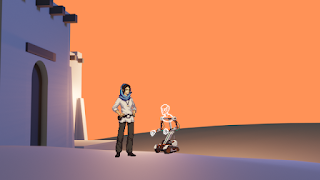
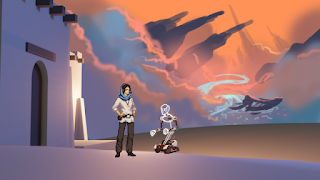
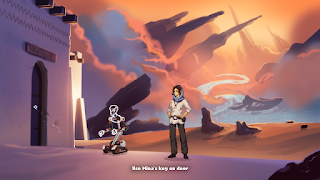
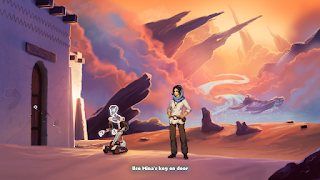
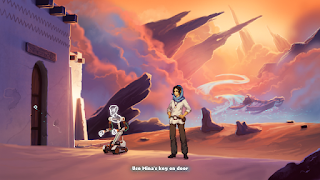
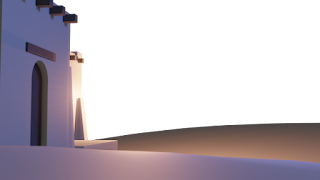
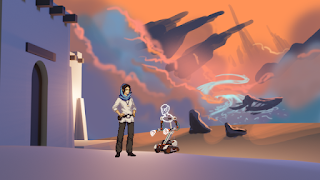
Process Breakdown - Using 3D as a base for a low resolution scene.
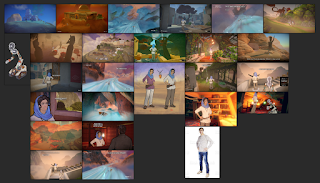
I've had a few different people ask me about my process for using 3D and for painting low resolution scenes, lately, so I've been sharing a basic step by step of this recent tribute to Heaven's Vault that I drew. I'm posting it here so that I can link people to it whenever they ask.
Step one is to gather reference files. Especially important because I'm paying homage to someone else's vision, and I want to try to be reasonably accurate. I have a mix of screenshots, concept art, pose references, anything that I think might be important. I use PureRef for handling my reference images, a wonderful free tool that I recommend to everybody working with reference material.
From this point on, it's just careful painting work, tweaking colour values, adjusting things for balance, and constantly checking my reference when adding detail to things like the ship and the buildings. Very few secrets here, just painting to the best of my ability and patience. Eventually I reach a point where I'm tired of painting detail, and any further painting is just fiddling, and I call the piece done. I then like to wait a couple of days, just to catch any stupid mistakes that I made because I was tired of working on the piece and rushing to get finished, and then it's finished for real. As soon as I show it to everybody, I notice all the mistakes, and vow to learn from these for next time.
Wednesday, September 22, 2021
The power of a workflow
Today I was working on character design, and I realized that I have not delineated my workflow here sufficiently. I have it well defined for the stages of creating a final drawing - lines, colour, shadows, etc, and have very clear notes, palettes and brushes created for this section of the work. What I'm missing, though, is the construction phase.
The issue is that when constructing my characters, I'm still relying on a lot of guesswork. I should know how many heads my character's proportions are - if not from memory, from a set of notes that I can check. I should be able to break the process of drawing a character's line art down into a series of constructive steps that solve things like posture, proportion, volume and silhouette. I do not currently have this in place. That meant that today was a poorly directed series of re-drawings, never quite focusing on a single element at a time. To have a carefully designed dynamic silhouette that is badly proportioned is not very useful. The same applies to spending a lot of time detailing overlapping volumes over a stiff or awkward pose. Said pose should be completely solved before I even begin to think about those volumes - just as the proportions should be measured and decided before working on the silhouette.
Happily, well documented processes for constructing figures exist in bountiful quantities, are well described, and quite sensibly illustrated with examples. My issues lies simply in my inexperience drawing in this style, and my focus has been largely on trying to figure out what the style actually is. Now that I have a good understanding of that, I need to go back to the basics of how to reach it from a blank page. I should have kept this in focus from the beginning, but being foolish and lazy has served me reasonably well to date, and therefore it takes days full of poorly directed efforts like today in order to be motivated enough to alter my methods and do things right.
For me, though, this is one of the best things about being a working illustrator. Art isn't a magic skill. You don't have to be born with it to succeed. You just need to learn the steps, one by one, and practice them. How hard can it be, right?
Thursday, September 16, 2021
Tinkering
As I look back on Old Skies in its current state, and try to work out my strengths and weaknesses at the moment, it occurs to me that my favourite aspect of game development is the act of tinkering about with a project. For me, tooling about in an engine or a piece of pixel art software was a bit like messing about with an electronics set - a chance to connect things together and see how they work, try to fix things that aren't working, and the chance to see something come to life. That's what drew me into game development in the first place.
When my focus shifted from writing functions and designing interactivity to making art, I found other ways to tinker - trying to find new ways of making cool graphics, learning different processes that added things to my toolbox of skills. It's always satisfying to me to do something that I didn't know how to do previously. Doing something I already knew how to do is satisfying, too, but in a different way.
I never really enjoyed making background art for games until I managed to find the fun in it, to break it down like that electronics kit into a series of steps that eventually results in something that works. I firmly believe that if you take someone and get them to do the thing that they truly care about, you can get great work out of anybody. For me, I think I need to find out how to tinker with the areas of my current work that are weaknesses, because that's what drives me.
It's important to me to produce good amounts of work, of course, one only has to peek at my todo lists to understand that if I didn't, things would very quickly be very bad for me. But I think if I can find that happy medium between tinkering and productivity in all current areas that I'm working in, the end result will be a better game. Can I make "character animations" part of that electronics kit? I guess it's something to work on!